I've always tried to be honest. I've written this blog with honesty over the years. It started as an exercise for a fledgling writer, and now it remains long after the writer has hung up his keyboard. Maybe another short story or two will find its way from my fingertips, but not just yet...
I wrote with honesty about my first wife's suicide and her struggles with post-partum anxiety and psychosis. I wrote about my kids, grief, finding love again... all with honesty. I've told stories about my father's cancer and the boy I almost killed in high school.
Today, I'm mustering that honesty to talk about my own mental health. About two months ago, I began ruminating--the process of going over and over the same mental ground with no resolution. The ruminations grew claws and panic attacks soon followed. On Tuesday morning before Thanksgiving, after a few short hours of sleep and a lot of ceiling gazing, I told Kim (my wife) I needed to see the doctor. I have no idea why anxiety cranked the heat this fall. I've staggered through times of trouble and rumination without my brain and body conspiring in such an insidious way in the past. Life is good right now. Really good... but the bitch anxiety doesn't care.
I've been on medication for five weeks now--one of those "six to eight weeks for full therapeutic dose" meds. I've gone back to see a therapist I first visited five years ago. Headspace has become my favorite app over the past few days.
We don't talk about mental health enough in this country--not yet. Not even after mass shootings and rising suicide rates. We don't talk about mental health in real, constructive ways. The disease model has dragged its feet through several incarnations of the DSM. We talk of "illness." Anyone diagnosed with anxiety, depression, OCD, or any number of other convenient labels is often deemed as sick or weak.
There's not a damn thing weak about having anxiety. It's a bitch. It undermines my good feelings and lets those ruminating lies run free. It's stolen my sleep. It made Thanksgiving dinner a marathon of "getting through" with all the chaos and bustle and family. It kicked me hard a couple of times on Christmas morning. I've kept plugging along, taking my pills, working on mindfulness, reminding myself that I haven't always felt this way and will not always feel this way.
I write a love letter to Kim every day. I use an add-on to have it delivered to her email inbox every morning. I've been doing this for more than five years now. This blog post is her love letter today. If it helps one person, good. If it reminds one person that they are not alone, good. If it gives one person pause before calling someone struggling with depression or anxiety or you-name-it weak, good. I love you, Kim. You give me courage.
It's time we all acknowledged that mental health is simply healthcare. It's the real thing to do--the only honest thing to do.

Showing posts with label thoughts on life. Show all posts
Showing posts with label thoughts on life. Show all posts
Tuesday, December 26, 2017


Tuesday, March 14, 2017
Making Meaning
If you call me the enemy often enough, does it make me one?
This is old ground... I am a heterosexual white male in my 40s who attends church (mostly) every Sunday and hails from a small town in Kansas. These are details, and maybe they are enough for you to "know" me. These are the details which have kept me (mostly) silent since Donald Trump was elected president.
Who needs another white, male, heterosexual voice from "rural America"?
I've kept silent because men like me are the enemy. In Sunday's op-ed (3/12/17), Leonard Pitts all but says I'm the problem. He points out a dichotomy between rural/city and Christian Fundamentalism/Secular Humanism as if clear bright lines separate these groups neatly as conservatives and liberals. His words ruffled me. Maybe because I'm a white, male, heterosexual voice from "rural America." Maybe not.
In our race to "understand how this happened" to our country, we've lost sight of a fundamental human reality--and a fundamental human need that goes along with it. The universe is a big place, and we spend our lives making meaning in it.
Personally, I've found solace in knowing I'm really not in control of anything. After Aimee's death, it was a comfort to know life was out of my control. Yes, a comfort. When I think about my father's slow descent and death after a brain tumor, I realize the same strange comfort shaped my youth.
The universe really is a helluva lot bigger than I am and it really doesn't give a shit what I think.
I've struggled with spirituality all my life--what my friend Heather calls my existential crisis. I've been a church-goer for most of my forty-plus years on the planet, but I'm not fundamental. Why do I go? It's simple really: I like the community. I like to be challenged. I love a reminder that I am what I am: ash and dust, mortal, small, and definitely not in control. Ash Wednesday is one of my favorite church nights because those messages about mortality are embedded in its very fabric: "For he knows how we were formed, aware that we were made from dust." (Psalm 103:14)
Do I really believe in God? Some days, yes. Others... Does it really matter?
The universe is bigger than me and doesn't really give a shit what I think or believe. I'll write here, in this blog, a tiny bit of my thoughts and feelings and my momentary reasons for being, but ultimately, the universe will keep spinning. But we, as humans, need meaning. It's a hole which too many of us fill with addictions and destructive behavior. It's that ache that wealth and status can't soothe. My core desire is to be a part of something bigger than me--bigger even than my "tribe" (which seems to have become a buzzword of late as we frantically try to fill the gaping holes in our lives). Like that line from "Helplessness Blues" by Fleet Foxes: "...a functioning cog in some great machinery serving something beyond me..." It's what I feel deep in my core, wherever and whatever that core is.
You call me an enemy, but I really just want to be a part of something that is serving the universe beyond me. I can only control what I can control... who I vote for, but not the color of my skin; what I write in this blog, but not the fact that I am a hetreosexual male; who I seek as allies, but not whether or not those allies want me on their side; the lending of my listening ear and empathetic heart, but not whether anyone will speak to me or trust me.
I am not the enemy nor am I on the other side of any simple dichotomy. I am just a man. A human. A cog hoping for a home in something far grander than I am alone.
My meaning in life is not to be anyone's enemy--nor will it ever be.
In our race to "understand how this happened" to our country, we've lost sight of a fundamental human reality--and a fundamental human need that goes along with it. The universe is a big place, and we spend our lives making meaning in it.
Personally, I've found solace in knowing I'm really not in control of anything. After Aimee's death, it was a comfort to know life was out of my control. Yes, a comfort. When I think about my father's slow descent and death after a brain tumor, I realize the same strange comfort shaped my youth.
The universe really is a helluva lot bigger than I am and it really doesn't give a shit what I think.
I've struggled with spirituality all my life--what my friend Heather calls my existential crisis. I've been a church-goer for most of my forty-plus years on the planet, but I'm not fundamental. Why do I go? It's simple really: I like the community. I like to be challenged. I love a reminder that I am what I am: ash and dust, mortal, small, and definitely not in control. Ash Wednesday is one of my favorite church nights because those messages about mortality are embedded in its very fabric: "For he knows how we were formed, aware that we were made from dust." (Psalm 103:14)
Do I really believe in God? Some days, yes. Others... Does it really matter?
The universe is bigger than me and doesn't really give a shit what I think or believe. I'll write here, in this blog, a tiny bit of my thoughts and feelings and my momentary reasons for being, but ultimately, the universe will keep spinning. But we, as humans, need meaning. It's a hole which too many of us fill with addictions and destructive behavior. It's that ache that wealth and status can't soothe. My core desire is to be a part of something bigger than me--bigger even than my "tribe" (which seems to have become a buzzword of late as we frantically try to fill the gaping holes in our lives). Like that line from "Helplessness Blues" by Fleet Foxes: "...a functioning cog in some great machinery serving something beyond me..." It's what I feel deep in my core, wherever and whatever that core is.
You call me an enemy, but I really just want to be a part of something that is serving the universe beyond me. I can only control what I can control... who I vote for, but not the color of my skin; what I write in this blog, but not the fact that I am a hetreosexual male; who I seek as allies, but not whether or not those allies want me on their side; the lending of my listening ear and empathetic heart, but not whether anyone will speak to me or trust me.
I am not the enemy nor am I on the other side of any simple dichotomy. I am just a man. A human. A cog hoping for a home in something far grander than I am alone.
My meaning in life is not to be anyone's enemy--nor will it ever be.
Monday, March 6, 2017
On Being a "Difficult" Parent
I'm officially intransigent. I think that means "difficult."
The last time Max had an infusion, one of his inflammation markers was elevated. I've learned that predicting a Crohn's flare up can be aguessing game er, prediction activity involving a slew of lab results and reports of clinical symptoms.
He'd just had an ear infection and ten days on antibiotics, so wonky labs could have been innocuous or a "false positive." It was also one result from a few inflammation markers checked every infusion--and the other numbers were fine. Evidently his GI specialist didn't think so, and through a rather uncomfortable round of "let's play triangulating communication" with me and his nurse a week after those labs, I learned he wanted to move Max to a six week rather than eight week infusion schedule.
Look, I know my kid is sick. He spent nearly five weeks in the hospital last winter before having three surgeries through June. But--and this is pretty crucial--Max hasn't reported a Crohn's symptom since the first surgery liberated him of a very sick colon.
I don't harbor illusions that my child is healed and cured of this disease. We travel to Kansas City for infusions every couple of months (I guess six weeks now) since last January. We make sure he takes his vitamins and anti-anxiety meds. I monitor how much he eats, his exercise--everything. I am not happy that the doctor is changing treatment based on a single lab result one time and the apparent dismissal of my explanation that Max has been symptom free (through the nurse triangulation channel, of course). I certainly am not happy such a thing happens without any examination or discussion with the patient.
In fact, his specialist used the word "intransigent" in an email to the nurse with whom we were triangulating to describe my attitude toward Max's symptoms in the past. Go on, look it up. Google that bad boy. Kind of sounds like an insult, right?
Before Max's hospital marathon, I may have misread some symptoms. I may have not understood the gravity of the disease and how things could spiral quickly. Max also struggles with anxiety, and I know the anxiety contributed to his downward spiral. This is how things happen with chronic diseases as families learn to manage and cope.
Things are different now. He has no colon. I monitor him more closely. He's receiving treatment and therapy to manage the anxiety And he's been doing well.
But now I'm a "difficult" parent. Intransigent. Pig-headed and stubborn and, in his specialist's opinion, blind to what's really going on with Max.
No.
I live with Max. I know what's going on. I know how many times he has a bowel movement every day. I know how he's feeling and what his worries are. I know what math group he's in and the book his reading group is devouring. I know his favorite Pokemon and the name he uses on Minecraft servers. I know he asked for a pill form of Benadryl before his infusions (given before Remicade) and I know the specialist hasn't bothered to change those orders to meet his request since making that request nearly six months ago. I also know that same specialist never had a conversation with Max's surgeon last spring. I know that's not necessarily how medicine works, but I know that's how I work. I know I expect more communication than a couple of phone calls with a nurse and a naughty note about me from the specialist to that nurse. I know I'm frustrated and sometimes mad as hell.
And I know, most of all, I love my son and will advocate for him to the best of my ability,
If that makes me "difficult," bring it on.

The last time Max had an infusion, one of his inflammation markers was elevated. I've learned that predicting a Crohn's flare up can be a
He'd just had an ear infection and ten days on antibiotics, so wonky labs could have been innocuous or a "false positive." It was also one result from a few inflammation markers checked every infusion--and the other numbers were fine. Evidently his GI specialist didn't think so, and through a rather uncomfortable round of "let's play triangulating communication" with me and his nurse a week after those labs, I learned he wanted to move Max to a six week rather than eight week infusion schedule.
Look, I know my kid is sick. He spent nearly five weeks in the hospital last winter before having three surgeries through June. But--and this is pretty crucial--Max hasn't reported a Crohn's symptom since the first surgery liberated him of a very sick colon.
I don't harbor illusions that my child is healed and cured of this disease. We travel to Kansas City for infusions every couple of months (I guess six weeks now) since last January. We make sure he takes his vitamins and anti-anxiety meds. I monitor how much he eats, his exercise--everything. I am not happy that the doctor is changing treatment based on a single lab result one time and the apparent dismissal of my explanation that Max has been symptom free (through the nurse triangulation channel, of course). I certainly am not happy such a thing happens without any examination or discussion with the patient.
In fact, his specialist used the word "intransigent" in an email to the nurse with whom we were triangulating to describe my attitude toward Max's symptoms in the past. Go on, look it up. Google that bad boy. Kind of sounds like an insult, right?
Before Max's hospital marathon, I may have misread some symptoms. I may have not understood the gravity of the disease and how things could spiral quickly. Max also struggles with anxiety, and I know the anxiety contributed to his downward spiral. This is how things happen with chronic diseases as families learn to manage and cope.
Things are different now. He has no colon. I monitor him more closely. He's receiving treatment and therapy to manage the anxiety And he's been doing well.
But now I'm a "difficult" parent. Intransigent. Pig-headed and stubborn and, in his specialist's opinion, blind to what's really going on with Max.
No.
I live with Max. I know what's going on. I know how many times he has a bowel movement every day. I know how he's feeling and what his worries are. I know what math group he's in and the book his reading group is devouring. I know his favorite Pokemon and the name he uses on Minecraft servers. I know he asked for a pill form of Benadryl before his infusions (given before Remicade) and I know the specialist hasn't bothered to change those orders to meet his request since making that request nearly six months ago. I also know that same specialist never had a conversation with Max's surgeon last spring. I know that's not necessarily how medicine works, but I know that's how I work. I know I expect more communication than a couple of phone calls with a nurse and a naughty note about me from the specialist to that nurse. I know I'm frustrated and sometimes mad as hell.
And I know, most of all, I love my son and will advocate for him to the best of my ability,
If that makes me "difficult," bring it on.

"My dad is pure evil."
(Elliot, age 5)
Monday, February 20, 2017
Dirt in My Veins
This is a love story.
I grew up in a small Kansas town, Clay Center, the county seat of--you guessed it--Clay County. The town has a spiffy web site now and a pretty bad-ass water park. When I lived there, the internet needed diaper changes and the water park was a Great Depression-era concrete-lined hole in the ground. Just under five thousand residents lived in Clay Center when I was in high school twenty-five years ago... and the population has been shrinking since.
Dirt and gravel roads criss-crossed Clay County, most of them laid out grid-like in sections. Drive a mile, and you would find a perpendicular section road. Order lived there, neat and tidy, except for the river. The Republican River snaked from the west to south-southeast of town and disturbed the grid. Driving close to the river, I found abrupt ends to gravel paths and dusty drops of twenty or thirty feet to the slowly rolling water below.
My heart fed on those roads and the mystery of overhanging trees and quiet fields. I would drive and drive and drive during lazy afternoons. Gas cost less then, less than a dollar a gallon, and my car was a sanctuary. There were secret places and shadowed hollows of public hunting land near river-bottom fields. Dead ends hid in the county's hills--like a cemetery I once found while driving Mom's four-speed Ford Ranger. The poor machine strained in reverse as I straddled ditches on either side for a quarter mile as we backed away from the locked gates.
Sometimes on lazy afternoons, I would drive away from my small town on a county highway and choose a gravel road to explore. I'd park on the roadside, half in/half out of the ditch, leave my car behind, pick a hill, and climb. I'd be lost to everyone for an hour or two. Alone. Invisible. Gone.
I couldn't live in Clay Center now. I've grown, and the seventeen-year-old me is long gone. He left a legacy in my veins, though. It's why I don't mind my brief commute through the rolling countryside into Jefferson County. It's why I value slow Saturdays and walks on wooded hillside trails on the edge of Lawrence. Northeast Kansas is a cousin to the home I knew, close but not the same.
My heart wants these things--hills to climb and grass and trees and time to just be. I ache for a time when I could disappear for a few hours, lost to everyone and everything.There's no magic in my Kansas memories... just gravel and dirt and plowed-under fields and the muddy swell of a river.
No magic, but plenty of love.
Hills to climb.
Roads to explore.
A love story.
I grew up in a small Kansas town, Clay Center, the county seat of--you guessed it--Clay County. The town has a spiffy web site now and a pretty bad-ass water park. When I lived there, the internet needed diaper changes and the water park was a Great Depression-era concrete-lined hole in the ground. Just under five thousand residents lived in Clay Center when I was in high school twenty-five years ago... and the population has been shrinking since.
Dirt and gravel roads criss-crossed Clay County, most of them laid out grid-like in sections. Drive a mile, and you would find a perpendicular section road. Order lived there, neat and tidy, except for the river. The Republican River snaked from the west to south-southeast of town and disturbed the grid. Driving close to the river, I found abrupt ends to gravel paths and dusty drops of twenty or thirty feet to the slowly rolling water below.
My heart fed on those roads and the mystery of overhanging trees and quiet fields. I would drive and drive and drive during lazy afternoons. Gas cost less then, less than a dollar a gallon, and my car was a sanctuary. There were secret places and shadowed hollows of public hunting land near river-bottom fields. Dead ends hid in the county's hills--like a cemetery I once found while driving Mom's four-speed Ford Ranger. The poor machine strained in reverse as I straddled ditches on either side for a quarter mile as we backed away from the locked gates.
Sometimes on lazy afternoons, I would drive away from my small town on a county highway and choose a gravel road to explore. I'd park on the roadside, half in/half out of the ditch, leave my car behind, pick a hill, and climb. I'd be lost to everyone for an hour or two. Alone. Invisible. Gone.
I couldn't live in Clay Center now. I've grown, and the seventeen-year-old me is long gone. He left a legacy in my veins, though. It's why I don't mind my brief commute through the rolling countryside into Jefferson County. It's why I value slow Saturdays and walks on wooded hillside trails on the edge of Lawrence. Northeast Kansas is a cousin to the home I knew, close but not the same.
My heart wants these things--hills to climb and grass and trees and time to just be. I ache for a time when I could disappear for a few hours, lost to everyone and everything.There's no magic in my Kansas memories... just gravel and dirt and plowed-under fields and the muddy swell of a river.
No magic, but plenty of love.
Hills to climb.
Roads to explore.
A love story.
Monday, February 13, 2017
On Persistence
Today we visit the ghost of words past...
I had originally written this for the Shimmer blog when they first published my short story, "The House was Never a Castle"--my first and only sale to that market. It's a fabulous publication, and I'm happy to note it is still drawing breath.
I value all the words, especially those from a time to which I cannot return. Persistence--resilience's first cousin--has so much value in life.
(Cue flashback music...)
My four-year-old son, Max, plays with the Soccer Hobbits on Saturday mornings, and no one keeps an “official” score. Soccer Hobbits focuses on playing, learning to love the game, experience, and fun. When Max pursues the ball during scrimmage, however, the look of grim determination on his face speaks all business. Max might not be as big or as fast as some of his peers, but he makes up for his lack of prowess with sheer guts and persistence. One tiny tap of the ball, even if it is stolen a microsecond later, proves enough to keep the fight in his tiny legs.
I can’t help but draw a parallel to what it takes to stay in the game as a writer.
Anyone can write. I have to believe as much to survive my day job as a high school English teacher. Some days are harder than others, for my students as well as me. Writing well and developing one’s craft requires patience. Patience requires a healthy dose of perspective. Since I started my writing journey four years ago, I’ve gained as much perspective as any bit of craft. Rejection is part of the game, and I’ve received my share. Each “no” used to sting like a solid punch in the gut, knocking the writing wind out of me.
But persistence requires a certain level of stubbornness despite little defeats. I listened to editors. I dusted off my knees and worked harder. I read. I’ve read the best in the field, devouring year’s best volumes, retrospective collections, award winners—trying to unlock the magic. Along the way, I identified what I liked, what worked and what didn’t, in the stories I read. I made a mental list. I wrote, too. Every day. Even days when I was too sick or tired or defeated to keep going, I forced at least one hundred words on a page, just as Max forces his little legs to keep pumping on the soccer field.
I first submitted to Shimmer in 2007. By my count, I’ve beleaguered the editorial staff with 27 manuscripts over the past few years. Persistence requires a writer to believe the next time will be it, the golden message, an acceptance letter with contract attached. It’s a sort of insanity, really, trying to find a home for one’s stories in highly competitive markets. For a writer to stay with the game, a writer must believe each story is better than the last, each story is a move forward.
And finally, most of all, a writer must be patient—as patient with her/himself as with a market’s submission wait-time. Craft does improve, only with time and effort; no “magic writing beans” exist, no overnight elixirs of brilliance. Stories need patience, too. Patience to develop. Patience for the characters and setting and plot cogs to snap together in the right way. Sometimes patience requires a story be set aside for months, as I did with “The House was Never a Castle.” I’m not the same writer I was when I first submitted to Shimmer back in 2007. I won’t be the same writer a year from now.
Max can keep playing soccer as long as he loves it; I’ll hammer away, story after story, page after page, word after word, putting my patience and persistence to the test.
I had originally written this for the Shimmer blog when they first published my short story, "The House was Never a Castle"--my first and only sale to that market. It's a fabulous publication, and I'm happy to note it is still drawing breath.
I value all the words, especially those from a time to which I cannot return. Persistence--resilience's first cousin--has so much value in life.
(Cue flashback music...)
My four-year-old son, Max, plays with the Soccer Hobbits on Saturday mornings, and no one keeps an “official” score. Soccer Hobbits focuses on playing, learning to love the game, experience, and fun. When Max pursues the ball during scrimmage, however, the look of grim determination on his face speaks all business. Max might not be as big or as fast as some of his peers, but he makes up for his lack of prowess with sheer guts and persistence. One tiny tap of the ball, even if it is stolen a microsecond later, proves enough to keep the fight in his tiny legs.
I can’t help but draw a parallel to what it takes to stay in the game as a writer.
Anyone can write. I have to believe as much to survive my day job as a high school English teacher. Some days are harder than others, for my students as well as me. Writing well and developing one’s craft requires patience. Patience requires a healthy dose of perspective. Since I started my writing journey four years ago, I’ve gained as much perspective as any bit of craft. Rejection is part of the game, and I’ve received my share. Each “no” used to sting like a solid punch in the gut, knocking the writing wind out of me.
But persistence requires a certain level of stubbornness despite little defeats. I listened to editors. I dusted off my knees and worked harder. I read. I’ve read the best in the field, devouring year’s best volumes, retrospective collections, award winners—trying to unlock the magic. Along the way, I identified what I liked, what worked and what didn’t, in the stories I read. I made a mental list. I wrote, too. Every day. Even days when I was too sick or tired or defeated to keep going, I forced at least one hundred words on a page, just as Max forces his little legs to keep pumping on the soccer field.
I first submitted to Shimmer in 2007. By my count, I’ve beleaguered the editorial staff with 27 manuscripts over the past few years. Persistence requires a writer to believe the next time will be it, the golden message, an acceptance letter with contract attached. It’s a sort of insanity, really, trying to find a home for one’s stories in highly competitive markets. For a writer to stay with the game, a writer must believe each story is better than the last, each story is a move forward.
And finally, most of all, a writer must be patient—as patient with her/himself as with a market’s submission wait-time. Craft does improve, only with time and effort; no “magic writing beans” exist, no overnight elixirs of brilliance. Stories need patience, too. Patience to develop. Patience for the characters and setting and plot cogs to snap together in the right way. Sometimes patience requires a story be set aside for months, as I did with “The House was Never a Castle.” I’m not the same writer I was when I first submitted to Shimmer back in 2007. I won’t be the same writer a year from now.
Max can keep playing soccer as long as he loves it; I’ll hammer away, story after story, page after page, word after word, putting my patience and persistence to the test.
Monday, February 6, 2017
Pencils
He surprised his roommate by returning ten minutes after the test started.
Roommate: Easy test?
Smart Guy: (holds up broken pencil) My pencil broke, so I quit.
Astonished? The first time I heard the story, I nodded with understanding. The smart guy had been a good friend of mine in high school, so I knew school wasn't really his thing regardless of IQ score. The story really isn't about pencils or college or intelligence or even truth. The story tells us about resilience--or the lack of it.
Resilience goes by many other names: grit or determination or willpower or being "scrappy." It's the ability to stick with something when roadblocks mount in front of you. It's what helps you over, under, through, or around those roadblocks so you can keep going. It's how you answer the big questions in life, like:
What are you going to do when your pencil breaks?
I taught English in a small northeast Kansas high school for thirteen years. Pencils, or the lack of them, were a common theme. Some students marched into class sans pencil (or other writing utensil) like the Light Brigade rode into the valley of Death, banners flying. Some students sulked into class without a pencil and tried their best Harry Potter with invisibility cloak impression in the back of the room. A student without a pencil is like a carpenter without a hammer, at least "way back" then. A former colleague would engage in a five to ten minute verbal sparring match with some of these kids as if yelling at them would make pencils magically appear.
I found it easy enough to leave a container of pencils at the front of my classroom. Problem solved and roadblock circumvented. We all need a healthy supply of resilience no matter our age, role, or lot in life. What are you going to do when students show up without their pencils? What are you going to do when things don't go your way?
Because they won't. Not most of the time, anyway.
I worry about my own kids all the time. Owen, my 8th grader, has decided not to use the pencils I bought for him at the start of the year. He has made it his goal to find pencils on the ground at school and use those instead. He has all year. Am I mad? Worried? No. I consider it training for a day when he's going to need to be resourceful--for that day when a roadblock arrives and he must conquer it. Pencils are fragile and sometimes forgotten. We all need the ability to keep going.
I worry about my own kids all the time. Owen, my 8th grader, has decided not to use the pencils I bought for him at the start of the year. He has made it his goal to find pencils on the ground at school and use those instead. He has all year. Am I mad? Worried? No. I consider it training for a day when he's going to need to be resourceful--for that day when a roadblock arrives and he must conquer it. Pencils are fragile and sometimes forgotten. We all need the ability to keep going.
So what will you do if your pencil breaks?


Monday, January 23, 2017
The First Rule, a Pre-History
1. It's not about you.
Rule #1 almost ended my first marriage before it began.
I was twenty-five, a second-year English teacher in a small, northeast Kansas town. I carried my heart on my sleeve and struggled with classroom discipline as many young teachers do. The students, after all, were only seven years younger than me, and many seniors had already kicked me around the previous year as juniors. The slippery slope of taking everything personally called like Homer's sirens.
When they misbehaved, I struggled. I raised my voice. I yelled. I made hollow threats and moved desks, sent students to the office for any provocation, and gave them plenty of ammunition to "stick it" to Mr. Polson. I did everything wrong--especially the amount of their baggage I decided to carry on my back. Everything became personal. Every voice out of compliance slapped me across the face; every touch of disrespect to anyone cut dagger-sharp into my gut.
I had it all wrong.
The truth comes easily after one's eyes open. All classroom discipline problems germinate from anger, frustration, and stress students carry into the room and/or baggage from home or their social lives. In my novice classroom, they translated that stress and baggage into rude comments, insults to me and other students, jeers and foolish acts and just about any other means to push my proverbial buttons, but none of it was personal. Stumbling at both life and teaching, I was the one who took everything personally, but it never started that way.
Back then, I didn't know. I was an easy target who didn't understand one of the most basic principles of living a good life.
I carried my frustration home and dumped all that inherited baggage on my fiance, Aimee. One day, she'd had enough. We went for a walk in a small, local arboretum, moonlight and stars playing on a pond. There, in the November chill with black lines of trees looking on, she gave me the ultimatum.
"Stop complaining about the students' behavior. Do something about it, but stop complaining. I don't want to marry someone who carries all their stuff home. It's not personal, you know."
I still remember those words. They crystallized in my brain. They tore at my heart. I'd already had one failed engagement, and now I felt the edge of this one slip beneath my feet. She hadn't uttered the sacred mantra of Rule #1, but her words came close. The meaning was there.
She could have easily said it: It's not about you.
Working on my classroom structure would take time. I couldn't fix student behavior or classroom environment overnight. But something did change inside me. Motivated by fear or love or a little of both, I sloughed away the baggage my students brought to class. No matter how wicked those students, their misbehaving really wasn't about me personally. A switch had been thrown deep inside and I would never be the same again in the classroom. Angry commands melted into patience and empathy. Demanding what I wanted morphed into quietly but consistently waiting for students to demonstrate compliance with my requests. Classroom expectations became clear. Over the years, it became easier for all of us, students and teacher alike.
It would be another eight years before Rule #1 formally came into my life, but I'd learned a lesson and learned it well.
Aimee and I were married the following summer, and Rule #1 helped me through the darkest parts of the journey ahead.
Rule #1 almost ended my first marriage before it began.
I was twenty-five, a second-year English teacher in a small, northeast Kansas town. I carried my heart on my sleeve and struggled with classroom discipline as many young teachers do. The students, after all, were only seven years younger than me, and many seniors had already kicked me around the previous year as juniors. The slippery slope of taking everything personally called like Homer's sirens.
When they misbehaved, I struggled. I raised my voice. I yelled. I made hollow threats and moved desks, sent students to the office for any provocation, and gave them plenty of ammunition to "stick it" to Mr. Polson. I did everything wrong--especially the amount of their baggage I decided to carry on my back. Everything became personal. Every voice out of compliance slapped me across the face; every touch of disrespect to anyone cut dagger-sharp into my gut.
I had it all wrong.
The truth comes easily after one's eyes open. All classroom discipline problems germinate from anger, frustration, and stress students carry into the room and/or baggage from home or their social lives. In my novice classroom, they translated that stress and baggage into rude comments, insults to me and other students, jeers and foolish acts and just about any other means to push my proverbial buttons, but none of it was personal. Stumbling at both life and teaching, I was the one who took everything personally, but it never started that way.
Back then, I didn't know. I was an easy target who didn't understand one of the most basic principles of living a good life.
I carried my frustration home and dumped all that inherited baggage on my fiance, Aimee. One day, she'd had enough. We went for a walk in a small, local arboretum, moonlight and stars playing on a pond. There, in the November chill with black lines of trees looking on, she gave me the ultimatum.
"Stop complaining about the students' behavior. Do something about it, but stop complaining. I don't want to marry someone who carries all their stuff home. It's not personal, you know."
I still remember those words. They crystallized in my brain. They tore at my heart. I'd already had one failed engagement, and now I felt the edge of this one slip beneath my feet. She hadn't uttered the sacred mantra of Rule #1, but her words came close. The meaning was there.
She could have easily said it: It's not about you.
Working on my classroom structure would take time. I couldn't fix student behavior or classroom environment overnight. But something did change inside me. Motivated by fear or love or a little of both, I sloughed away the baggage my students brought to class. No matter how wicked those students, their misbehaving really wasn't about me personally. A switch had been thrown deep inside and I would never be the same again in the classroom. Angry commands melted into patience and empathy. Demanding what I wanted morphed into quietly but consistently waiting for students to demonstrate compliance with my requests. Classroom expectations became clear. Over the years, it became easier for all of us, students and teacher alike.
It would be another eight years before Rule #1 formally came into my life, but I'd learned a lesson and learned it well.
Aimee and I were married the following summer, and Rule #1 helped me through the darkest parts of the journey ahead.
Monday, October 17, 2016
The Demon Speaks!
I'm the villain some are talking about. I'm a white man in his early 40s, heterosexual, and I go to church most Sundays. Hell, I'm even from a small town in Kansas and I'm angry (because of this damned election). You might see where this is going. Those are words and labels, but here are some details:

My mother's family goes back... way back. Not Native peoples back, but back like Mayflower back. Like my great-grand-something fell off the Mayflower. He was an indentured servant to one of the families on the boat. I heard this called a "debt bondage" on NPR the other day, and most indentured servants never survived the repayment of their debt. It was slavery with a sunset, and even forced slaves were "indentured" at first. (I feel another post coming, one about the history of race in America and the current state of affairs in this country citing nefarious laws around the time of Bacon's Rebellion, but that's for another day.)
But I'm white. Euro-American. Swedish/French/English-American. And a man. Words, words, words.
But I'm white. Euro-American. Swedish/French/English-American. And a man. Words, words, words.
So yeah, I'm the villain. The devil. Fear me. The white, hetero, Christian guy who you may assume would vote for "he-who-must-not-be-named" but shares a first name with a certain cartoon duck. Maybe that's why certain people put "the" in front of it. The Donald is not as easily confused with Donald Duck.
You see where these words could take us, right?
You see where any of these easy stereotypes take us, right?
Words have power, and the words we're choosing at this point in history worry me.
Words have power, and the words we're choosing at this point in history worry me.
Please understand I'm a lover of words and my First Amendment rights. Years ago, in college, I had this great Rock the Vote T-shirt which proclaimed "Censorship is Un-American." You might remember the one:

Yeah, well, I've not said a word about this God-forsaken election cycle because I've been cautioned. I'm a public servant, see, and shouldn't go too political. That's the professional thing to do. It's also the Un-American thing to do.
We know all about Un-American things, right? Like threatening to jail one's political opponents. That's just not something we do. Like turning our back on our values and convictions because we've been made to fear. "I know what he says about (and maybe does to) women, but I'm afraid." This fear raises its head in polls all the time. It wears the mask of security and protecting our borders. It hides the shameful villainy of misogyny and bigotry.
I'm done. I don't like living in fear and I certainly don't like what fear has done to this country. I also feel like it's pretty damn Un-American to equate our country with a post-apocalyptic hell for political gain. The rhetoric of this election has taken us to the linguistic breach. The words our political parties have chosen--and no one is completely innocent here--have seeped into our collective dialogue. Our words become our thoughts and shape our reality. Reality has become a little bleak.
When our words are reduced to hate and fear, we all lose. I am no demon. I am a human, just a human. I go to church--a pretty liberal, open and affirming UCC church in a college town--almost every week because I need to be part of something bigger than me. I care about my wife and my kids and their gay uncles. I can't change my whiteness, my maleness, or my hetero-ness, but I can chose the words I use and which words I choose to follow. I would never vote for anyone who makes me feel fear because fear is the real enemy.
I worry for this country. I worry for my children and my grandchildren, but I will not prostrate myself to fear. My great-grand-something served his years of indentured servitude nearly four hundred years ago, and we are--all of us--still crawling toward freedom.
When our words are reduced to hate and fear, we all lose. I am no demon. I am a human, just a human. I go to church--a pretty liberal, open and affirming UCC church in a college town--almost every week because I need to be part of something bigger than me. I care about my wife and my kids and their gay uncles. I can't change my whiteness, my maleness, or my hetero-ness, but I can chose the words I use and which words I choose to follow. I would never vote for anyone who makes me feel fear because fear is the real enemy.
I worry for this country. I worry for my children and my grandchildren, but I will not prostrate myself to fear. My great-grand-something served his years of indentured servitude nearly four hundred years ago, and we are--all of us--still crawling toward freedom.
Wednesday, June 15, 2016
When You Attack My Family
Tears came as I drove my four-year-old son home from preschool yesterday. I had been doing a good deal of processing since the heinous attack on an Orlando nightclub early Sunday morning. Many voices have risen, and mine is perhaps the least important among the crowd. After hearing commentary from the Justin Torres of the Washington Post yesterday on All Things Considered as we drove home, the dam broke.
Mr. Torres uses the word "sacredness" to describe the club in his Post essay (In Praise of Latin Night at the Queer Club). On NPR he says "people talk about the gay bar like it is church."
Look, I'm a white, middle-aged straight man from Kansas. On the surface, I'm as far from Latin Night at Pulse as anyone in this country. But I've been there--different city, different club--and I've seen that sacredness first-hand on the face of some of my closest friends.
No, not friends. Family.
When you realize this attack was on us, our family, it changes everything. Those weren't "just" gays, or Latinos, or whatever-box-you-might-try-to-put-them-in-to-make-you-feel-safe. They were us. Our brothers and sisters and family.
My heart breaks when I hear of this tragic event bastardized into Islamophobia or a rallying cry for the gun-crazed Right and their "out of my cold, dead hands" mentality. Our Muslim brothers and sisters are family, too, and they've suffered at the hands of men who look a lot like me. I grew up in a small town in which everyone owned guns, hunting was a way of life, and shooting cans of Barbasol to watch them explode in a cloud of foam was just "something to do" on lazy Saturday afternoons. The sacredness of church, mosque, synagogue, or gay club does not stop at the second amendment.
I shed tears on the drive home yesterday for all of us--gay, straight, Muslim, Christian, Latino, black, white, whatever-you-are. I shed tears for the sanctity of life and how awfully easy it is to have that life stolen. I shed tears for all of us, our American family, and how God-awfully dysfunctional we can be.
I'll pick up my son again this afternoon. There will be more NPR coverage of Orlando. He will one day grow old enough to talk about such tragedies. I hope and pray I can help him understand what the word sacred means in exactly the context Mr. Torres used it. I hope and pray he will know the meaning of family, too.
***
Listen to "'These Are My People': Writer Reflects on Orlando Attack in 'Washington Post'"
Read "In Praise of Latin Night at the Queer Club
Sunday, May 15, 2016
My Soccer Riot
I'm going to own something publicly of which I am not proud.
Yesterday, my oldest son's soccer team played for their end of the year championship, something the local league calls the "classic cup." I love my son. I love watching him play. I work hard to be positive, cheer for the team, encourage them, and leave my passion on display.
There are certain lines I will not cross--and yesterday was no different. I will not yell at or berate the children on the field. I will not shout profanities. But my passion is on display. It always has been, and yesterday was no different.
The local league reminds us each year of general rules for parents. I've supported this league with thousands of dollars over the years so my children can play and learn the value of teamwork, hard work, and losing. The value of winning comes easily; it's losing which requires character. I am proud of my son and the character he displays regardless of any game's outcome.
A friend once told me there are three teams on a field during any sporting event--and no one is rooting for the third. The officials have a hard job and often face abuse from angry fans. I am human and as such fundamentally flawed. I am not above my passion bubbling over when officiating begins to affect the outcome of a game even though I try, with all my being, to teach my son that officials, for better or worse, are part of playing.
Maybe it was the goal scored from an offside position when the linesman was out of position to call the play (I generally watch from our team's defensive sideline). Maybe it was the foul called against one my son's teammates as he was shoved to the ground (if you are confused, so was I). Maybe it was the fact the head referee taunted the aforementioned player with a red card after he questioned the call. Maybe it was the several shots taken at my son while he carried the ball or other continued violent play without recourse. Maybe it was a combination of these miscues which bubbled over as another one of our players was ejected with a red card and my passion spilled over.
Again, I did not swear or curse or target a kid from the other team. I simply said the officiating was "bush league" and "sorry boys, looks like you're playing against two teams today."
I'm not proud of these things. Maybe part of my brain knew I wouldn't be because I certainly did not shout them at the top of my lungs. Another parent fired a few remarks in my direction after my comments, the kindest of which was "calm down."
I've grown tired of the world in which I must counsel young people through the insults they heap upon each other from a position of anonymity. Social media and the privilege of distance has eroded human decency. Spend a New York minute reading comments on most popular YouTube videos and you have a quick and dirty lesson. And yes, I recognize I flung comments onto the field with relative anonymity, too. I am not proud or innocent.
I walked over to the man for a face to face and asked if he had anything he would like to say to me. I was angry, seeing red, but by God, after forty-one years of life simply taking it, I was not going to take it any more. I am not proud--but a little conflicted because there reaches a point when we must own our actions.
I did not use profanity or insult any of the children. I simply wanted the opportunity to face someone who clearly had something he wanted to say about me if not to me. I am not proud it came to that opportunity. I am happy I walked away a moment later because anger rarely gives birth to anything positive.
My son's team lost the game 1-0. He is my role model for life, teaching me that winning and losing come in equal measure. I am proud of him and everything he has weathered in less than thirteen years on the planet. As I walked to the medal ceremony, a felt the sting of a few more comments aimed in my general direction. The moment of heat and passion gone, I continued walking. There will be more games and thankfully more opportunities for me to do it better.
We must do our best to recognize humanity in others. If we don't, no one will.
Yesterday, my oldest son's soccer team played for their end of the year championship, something the local league calls the "classic cup." I love my son. I love watching him play. I work hard to be positive, cheer for the team, encourage them, and leave my passion on display.
There are certain lines I will not cross--and yesterday was no different. I will not yell at or berate the children on the field. I will not shout profanities. But my passion is on display. It always has been, and yesterday was no different.
The local league reminds us each year of general rules for parents. I've supported this league with thousands of dollars over the years so my children can play and learn the value of teamwork, hard work, and losing. The value of winning comes easily; it's losing which requires character. I am proud of my son and the character he displays regardless of any game's outcome.
A friend once told me there are three teams on a field during any sporting event--and no one is rooting for the third. The officials have a hard job and often face abuse from angry fans. I am human and as such fundamentally flawed. I am not above my passion bubbling over when officiating begins to affect the outcome of a game even though I try, with all my being, to teach my son that officials, for better or worse, are part of playing.
Maybe it was the goal scored from an offside position when the linesman was out of position to call the play (I generally watch from our team's defensive sideline). Maybe it was the foul called against one my son's teammates as he was shoved to the ground (if you are confused, so was I). Maybe it was the fact the head referee taunted the aforementioned player with a red card after he questioned the call. Maybe it was the several shots taken at my son while he carried the ball or other continued violent play without recourse. Maybe it was a combination of these miscues which bubbled over as another one of our players was ejected with a red card and my passion spilled over.
Again, I did not swear or curse or target a kid from the other team. I simply said the officiating was "bush league" and "sorry boys, looks like you're playing against two teams today."
I'm not proud of these things. Maybe part of my brain knew I wouldn't be because I certainly did not shout them at the top of my lungs. Another parent fired a few remarks in my direction after my comments, the kindest of which was "calm down."
I've grown tired of the world in which I must counsel young people through the insults they heap upon each other from a position of anonymity. Social media and the privilege of distance has eroded human decency. Spend a New York minute reading comments on most popular YouTube videos and you have a quick and dirty lesson. And yes, I recognize I flung comments onto the field with relative anonymity, too. I am not proud or innocent.
I walked over to the man for a face to face and asked if he had anything he would like to say to me. I was angry, seeing red, but by God, after forty-one years of life simply taking it, I was not going to take it any more. I am not proud--but a little conflicted because there reaches a point when we must own our actions.
I did not use profanity or insult any of the children. I simply wanted the opportunity to face someone who clearly had something he wanted to say about me if not to me. I am not proud it came to that opportunity. I am happy I walked away a moment later because anger rarely gives birth to anything positive.
My son's team lost the game 1-0. He is my role model for life, teaching me that winning and losing come in equal measure. I am proud of him and everything he has weathered in less than thirteen years on the planet. As I walked to the medal ceremony, a felt the sting of a few more comments aimed in my general direction. The moment of heat and passion gone, I continued walking. There will be more games and thankfully more opportunities for me to do it better.
We must do our best to recognize humanity in others. If we don't, no one will.
Thursday, January 1, 2015
On Bullying
I know I've written about bullying before, but recent events have hurt someone dear to me. Please forgive. I'm starting this at 4-something in the morning because I'm mad. In my neck of the woods, we sometimes say "pissed" when one is this mad. Not "pissed" drunk like our friends across the pond, but "pissed off."
I am.
I'm tired of bullies. I'm tired of them at my job as a middle school/high school guidance counselor and I'm tired of the unfortunate reality that bullies exist as adults, too. Once upon a time, I believed in some fairy tale version of adulthood in which all the bullies matured and shed their evil skin. Like all fairy tales, this one is fiction.
Bullies are everywhere and every age, and if they've shed any skin, it's only to grown a more insidious one in its place.
The bullies at school are sneaky. A teacher turns away and one boy punches another. They wait until I pass during lunch duty, and call their target names. In many ways, the girls are worst. I could relate scores of personal examples from my job, and it wouldn't take much to do a simple Google search and find stacks of digital articles on the subject.
Females--girls and grown women--like to do their bullying in different ways than boys. They often ostracize and exclude. They post hideous untruths online and laugh when their target's life falls apart. They've found ways to belittle via social media I shudder to recall. The motives are varied, but one constant keeps surfacing: if one is the bully, it steers attention to someone else. In the bully's mind, as long as someone else is the target, it's not her.
It hurts me to watch the cruelty at my job and hurts me in my neighborhood. Yes, my neighborhood lives in the shadow of a bully and I'm tired of it. Just like the girls at school, adult bullies ostracize and exclude. They manipulate and maneuver to make sure the target is not them. Sometimes the cruelty wears the most subtle cloak--for example, repeatedly leaving someone's name off a mailing list about neighborhood activities.
I was the target of bullying in middle school. The ride from my school to the high school for band class in 7th grade was especially agonizing. We would load the unsupervised bus--because let's be honest about the driver's ability to both drive and make sure passengers weren't being douche bags--and take a five minute jaunt from one school to the other. I heard "fag" and "gay" more times than I could count during those five minutes. A group of boys a year or two older than me would hound me after school during an arduous walk home. The walk was only four blocks, but it felt like four hundred.
Sometimes I feel so powerless when confronted with bullying at my job. It's especially difficult as an adult in my own neighborhood. No one--not one living creature--has the right to make anyone else feel like those ass hats made me feel in middle school. It turns my stomach that so many continue their cruelty long after the bus engine has gone cold.
So what do we do? Talk about it... write about it. Stand up and be counted among those who will not tolerate such behavior. There are more victims than bullies, and like most forms of darkness, this one cannot stand the light.
I am.
I'm tired of bullies. I'm tired of them at my job as a middle school/high school guidance counselor and I'm tired of the unfortunate reality that bullies exist as adults, too. Once upon a time, I believed in some fairy tale version of adulthood in which all the bullies matured and shed their evil skin. Like all fairy tales, this one is fiction.
Bullies are everywhere and every age, and if they've shed any skin, it's only to grown a more insidious one in its place.
The bullies at school are sneaky. A teacher turns away and one boy punches another. They wait until I pass during lunch duty, and call their target names. In many ways, the girls are worst. I could relate scores of personal examples from my job, and it wouldn't take much to do a simple Google search and find stacks of digital articles on the subject.
Females--girls and grown women--like to do their bullying in different ways than boys. They often ostracize and exclude. They post hideous untruths online and laugh when their target's life falls apart. They've found ways to belittle via social media I shudder to recall. The motives are varied, but one constant keeps surfacing: if one is the bully, it steers attention to someone else. In the bully's mind, as long as someone else is the target, it's not her.
It hurts me to watch the cruelty at my job and hurts me in my neighborhood. Yes, my neighborhood lives in the shadow of a bully and I'm tired of it. Just like the girls at school, adult bullies ostracize and exclude. They manipulate and maneuver to make sure the target is not them. Sometimes the cruelty wears the most subtle cloak--for example, repeatedly leaving someone's name off a mailing list about neighborhood activities.
I was the target of bullying in middle school. The ride from my school to the high school for band class in 7th grade was especially agonizing. We would load the unsupervised bus--because let's be honest about the driver's ability to both drive and make sure passengers weren't being douche bags--and take a five minute jaunt from one school to the other. I heard "fag" and "gay" more times than I could count during those five minutes. A group of boys a year or two older than me would hound me after school during an arduous walk home. The walk was only four blocks, but it felt like four hundred.
Sometimes I feel so powerless when confronted with bullying at my job. It's especially difficult as an adult in my own neighborhood. No one--not one living creature--has the right to make anyone else feel like those ass hats made me feel in middle school. It turns my stomach that so many continue their cruelty long after the bus engine has gone cold.
So what do we do? Talk about it... write about it. Stand up and be counted among those who will not tolerate such behavior. There are more victims than bullies, and like most forms of darkness, this one cannot stand the light.
Monday, September 15, 2014
For My Future Granddaughter
I bought one of these on eBay a few weeks ago:

I paid a premium, quite a bit higher than retail. The set, rather small and originally retailing for just $19.95, has made quite a few Lego resellers fat stacks of profit as they scooped them by the cart load and flipped on eBay, Amazon, and other you-sell-it sites. I'll admit I do a little Lego "investing," too, but not on the scale as major resellers. I've held onto a few Star Wars sets and made a few bucks. Kim can tell you about the Monster Fighters Haunted House on a shelf out in the garage. (Or maybe she can't... it's packed neatly in an inconspicuous brown box.)
One of the big rules of Lego investing is one should enter at a low price. It's frighteningly like the stock market, at at web sites like Brickpicker.com, it's treated as such. Buy low and sell high. Hold for the long term or occasionally find one of those glorious penny stocks which appreciates rapidly and can be sold short term for huge profits. The cheapest Research Institute available on eBay US as of this writing will cost you $70.04 including shipping. Yes, more than triple the MSRP.
So why break such a cardinal rule to get my hands on this set? Do I see the price rising even higher?
Sure, maybe. But this one isn't for sale. I wanted to grab a RI for my granddaughter. (This is where the audience gasps, thinking something like, "Isn't your oldest kid like a freshmen in high school?")
Look, this isn't a family blog, per se, but no one here is pregnant.
I'm looking down the road here. Waaaaay down the road. Lego's Research Institute made a huge splash largely because... look closely at the box... it features three female scientists. It garnered a lot of media attention last month, including this article from the New York Times, this op-ed in the Chicago Tribune, and an online petition to resurrect the set after its too-short life.
So I mentioned I'm looking down the road. Waaaaay down the road, but the RI isn't about "investing" in the traditional sense. I want to gift this to my future granddaughter because her world (hopefully) will be different than the one in which we live. I want to give it to her and let her know how happy I am she is able to do whatever she wants. I want her to know how happy I am she lives in a world in which a toy set featuring female scientists is no longer a big deal because everyone knows women can kick ass at anything they do.
That's the best investment I can imagine and a world in which I want everyone to live.
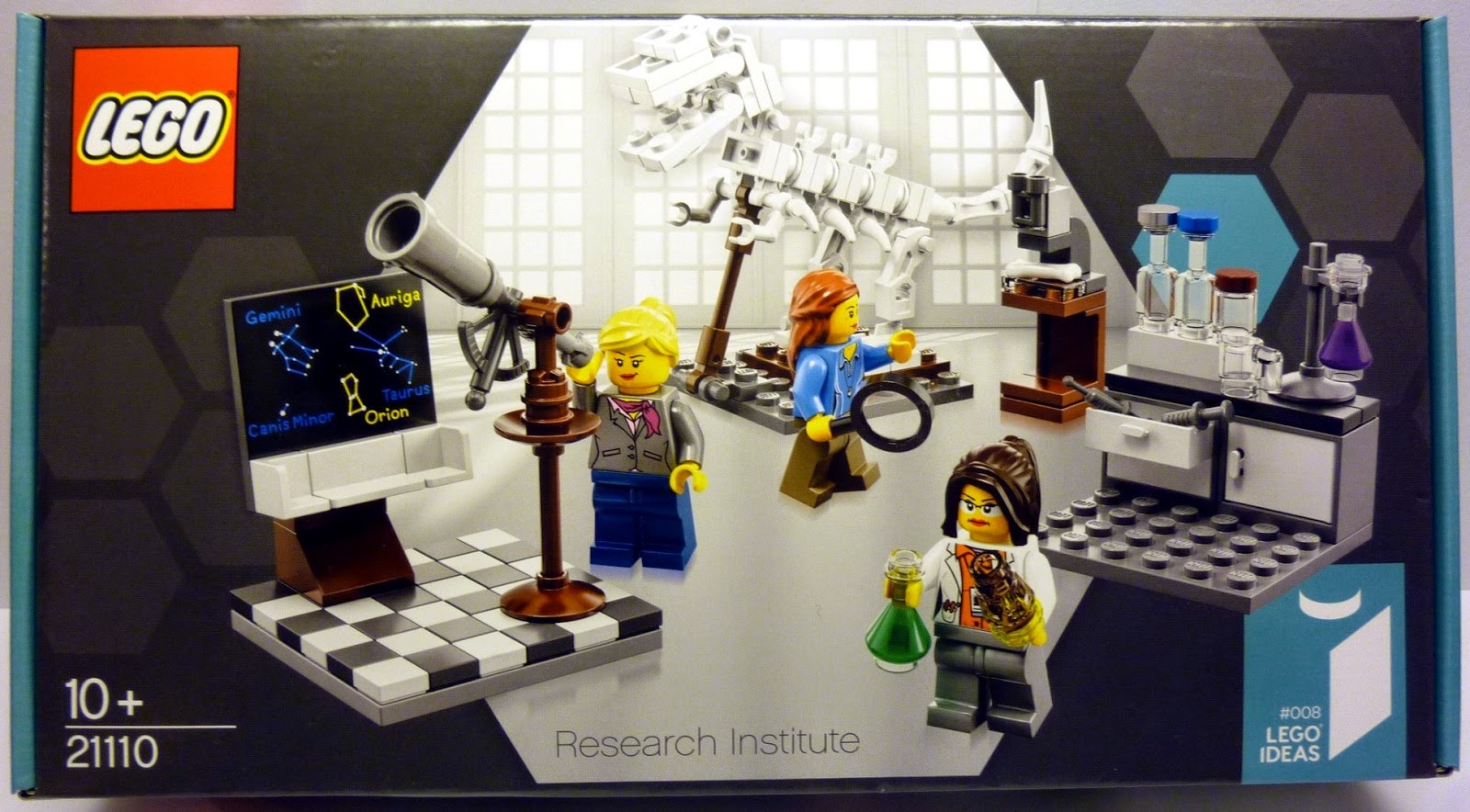
LEGO 21110 Research Institute
I paid a premium, quite a bit higher than retail. The set, rather small and originally retailing for just $19.95, has made quite a few Lego resellers fat stacks of profit as they scooped them by the cart load and flipped on eBay, Amazon, and other you-sell-it sites. I'll admit I do a little Lego "investing," too, but not on the scale as major resellers. I've held onto a few Star Wars sets and made a few bucks. Kim can tell you about the Monster Fighters Haunted House on a shelf out in the garage. (Or maybe she can't... it's packed neatly in an inconspicuous brown box.)
One of the big rules of Lego investing is one should enter at a low price. It's frighteningly like the stock market, at at web sites like Brickpicker.com, it's treated as such. Buy low and sell high. Hold for the long term or occasionally find one of those glorious penny stocks which appreciates rapidly and can be sold short term for huge profits. The cheapest Research Institute available on eBay US as of this writing will cost you $70.04 including shipping. Yes, more than triple the MSRP.
So why break such a cardinal rule to get my hands on this set? Do I see the price rising even higher?
Sure, maybe. But this one isn't for sale. I wanted to grab a RI for my granddaughter. (This is where the audience gasps, thinking something like, "Isn't your oldest kid like a freshmen in high school?")
Look, this isn't a family blog, per se, but no one here is pregnant.
I'm looking down the road here. Waaaaay down the road. Lego's Research Institute made a huge splash largely because... look closely at the box... it features three female scientists. It garnered a lot of media attention last month, including this article from the New York Times, this op-ed in the Chicago Tribune, and an online petition to resurrect the set after its too-short life.
So I mentioned I'm looking down the road. Waaaaay down the road, but the RI isn't about "investing" in the traditional sense. I want to gift this to my future granddaughter because her world (hopefully) will be different than the one in which we live. I want to give it to her and let her know how happy I am she is able to do whatever she wants. I want her to know how happy I am she lives in a world in which a toy set featuring female scientists is no longer a big deal because everyone knows women can kick ass at anything they do.
That's the best investment I can imagine and a world in which I want everyone to live.
Wednesday, August 27, 2014
On Being from Kansas
Here come the Wizard of Oz jokes...
And that's the first thing you need to know about being a Kansan. You and your home state are often the butt of jokes--stale, tired jokes which are told with impunity.
"Where's Toto?"
"Where's Auntie Em?"
"Where's [insert any Oz character name here]?
When I worked at a grocery store in high school, one "import" family would shop wearing matching "We're not in Kansas anymore" t-shirts. True story. They'd come in on a weeknight around 9 PM, an hour before close, and wander the aisles in those shirts.

It goes beyond Oz. I've known folks from more populous states/the coasts who really, truly seem to believe we still use Conestoga wagons for transport. Ha ha. Our state is flat as a pancake... a few years ago, one mathematician "proved" Kansas, relatively, was flatter than a pancake. And it's not as if our state government helps us much. We've suffered embarrassing State Board of Education fights over evolution and passed legislation requiring voter ID, because, as you know, massive amounts of illegal immigrants flock to Kansas so they can vote illegally. I hear they're bused in, in fact. "It's all those damn Democrats' doin'!" wails the old man with belly-length beard next to the spittoon.
I say "we," but I never voted for such a thing. Maybe our collective unconscious remembers a time when "illegal" voters did arrive in our fair state (before it was a state). But that, dear friends, was before the American Civil War... back when Kansas meant something progressive and on the edge. Bleeding Kansas. In the years leading to the most deadly conflict in United States history, the first shots were fired here. Legendary terrorists like John Brown murdered in the name of abolition and William Quantrill burned my adopted city, Lawrence, to the ground.

Our state motto, Ad Astra Per Aspera, reflects on the struggle to join the Union.
To the Stars Through Difficulty.
That's good stuff. That's why I'm proud to be a Kansan despite the jokes and hayseed assumptions. I'm proud to be a Kansan despite our own failings and weaknesses. This is a place where people understand suffering and sacrifice. This is a place of good, hearty people who tell the truth. Honesty is valued here and hard work, too.
Maybe it's because of our position as butt of so many national jokes that Kansans have become so patient. There's intolerance here--unfortunately more than I want to believe at times--but when you meet a Kansan one-on-one, the facades of bigotry often melt away. Not always, but often enough to know something good lies within. We know we have warts. We know we have scars. But, from my experience, we own them. Maybe not every individual... but a collective "we." One cannot have suffered repeated offenses without developing a degree of humility.
A Kansan knows it isn't very humble to speak of one's humility. We know we are broken as much as anyone else, but we are also aware of our humanity. We want good, honest stories more than we need grand lectures from any pulpit--even a secular one.
I work as a guidance counselor in a small, Northeast Kansas high school. Every year, we receive at least one new student from some other portion of the country--California, Florida, Michigan in the last few years--and are charged with the care of this adolescent. We joke that we're supposed to "save" them because we are used to being the brunt of jokes."Send the boy to Kansas. They'll learn him right. And if not... there's nothing to do out there, anyway."
We take this "orphan" in an make him our own. We care for her and teach her how to be good to other people and that she matters. We build relationships. We listen. We try again when we fail because we know--thanks to lessons from our rough climate won by generations of farmers and ranchers--failure is coming.
But so is triumph, little victories of the most mundane, everyday variety.
Go on. Make fun of us. Ask about Toto (the dog not the band). Try and win us with golden tongues and well-formed words. Just be honest. Genuine. Flawed and human. If you are, you just might belong here:

And that's the first thing you need to know about being a Kansan. You and your home state are often the butt of jokes--stale, tired jokes which are told with impunity.
"Where's Toto?"
"Where's Auntie Em?"
"Where's [insert any Oz character name here]?
When I worked at a grocery store in high school, one "import" family would shop wearing matching "We're not in Kansas anymore" t-shirts. True story. They'd come in on a weeknight around 9 PM, an hour before close, and wander the aisles in those shirts.
(sic 'em, Toto)
It goes beyond Oz. I've known folks from more populous states/the coasts who really, truly seem to believe we still use Conestoga wagons for transport. Ha ha. Our state is flat as a pancake... a few years ago, one mathematician "proved" Kansas, relatively, was flatter than a pancake. And it's not as if our state government helps us much. We've suffered embarrassing State Board of Education fights over evolution and passed legislation requiring voter ID, because, as you know, massive amounts of illegal immigrants flock to Kansas so they can vote illegally. I hear they're bused in, in fact. "It's all those damn Democrats' doin'!" wails the old man with belly-length beard next to the spittoon.
I say "we," but I never voted for such a thing. Maybe our collective unconscious remembers a time when "illegal" voters did arrive in our fair state (before it was a state). But that, dear friends, was before the American Civil War... back when Kansas meant something progressive and on the edge. Bleeding Kansas. In the years leading to the most deadly conflict in United States history, the first shots were fired here. Legendary terrorists like John Brown murdered in the name of abolition and William Quantrill burned my adopted city, Lawrence, to the ground.
(A Painting Depicting Quantrill's raid from the LJ World)
Our state motto, Ad Astra Per Aspera, reflects on the struggle to join the Union.
To the Stars Through Difficulty.
That's good stuff. That's why I'm proud to be a Kansan despite the jokes and hayseed assumptions. I'm proud to be a Kansan despite our own failings and weaknesses. This is a place where people understand suffering and sacrifice. This is a place of good, hearty people who tell the truth. Honesty is valued here and hard work, too.
Maybe it's because of our position as butt of so many national jokes that Kansans have become so patient. There's intolerance here--unfortunately more than I want to believe at times--but when you meet a Kansan one-on-one, the facades of bigotry often melt away. Not always, but often enough to know something good lies within. We know we have warts. We know we have scars. But, from my experience, we own them. Maybe not every individual... but a collective "we." One cannot have suffered repeated offenses without developing a degree of humility.
A Kansan knows it isn't very humble to speak of one's humility. We know we are broken as much as anyone else, but we are also aware of our humanity. We want good, honest stories more than we need grand lectures from any pulpit--even a secular one.
I work as a guidance counselor in a small, Northeast Kansas high school. Every year, we receive at least one new student from some other portion of the country--California, Florida, Michigan in the last few years--and are charged with the care of this adolescent. We joke that we're supposed to "save" them because we are used to being the brunt of jokes."Send the boy to Kansas. They'll learn him right. And if not... there's nothing to do out there, anyway."
We take this "orphan" in an make him our own. We care for her and teach her how to be good to other people and that she matters. We build relationships. We listen. We try again when we fail because we know--thanks to lessons from our rough climate won by generations of farmers and ranchers--failure is coming.
But so is triumph, little victories of the most mundane, everyday variety.
Go on. Make fun of us. Ask about Toto (the dog not the band). Try and win us with golden tongues and well-formed words. Just be honest. Genuine. Flawed and human. If you are, you just might belong here:

The Flint Hills of Kansas seen from the air (Jim Richardson, National Geographic)
(Flat as a what?)
Thursday, July 31, 2014
Why Readers, Scientifically, are People, Too
A few weeks ago my dear sister shared an article titled "Why Readers, Scientifically, Are The Best People To Fall In Love With." Improper title capitalization rules and superfluous prepositions aside, I take issue with the article. What would one expect, coming from Elite Daily, a site, I must admit, I hadn't stumbled across before but calls itself "the voice of Generation Y." Isn't that a perfect title for a Gen Y site? Elite. Yes, yes you are. Maybe that's my problem. As a Gen Xer, I'm an old fart, skeptical of everything.
Even myself. And I'm also not all that special. I'm just a person with an opinion and about three pounds of neurons in my skull, but I do like to think.
I learned the habit of asking questions of EVERYTHING in undergrad at Kansas State University, probably even before that. Richard Fogg, if you're out there, your lab section of Psych 350: Experimental Methods in Psychology way back in the fall of 1995 was brilliant. Thanks for teaching me true inquiry, critical thinking, and objectivity--and the cool lesson about what happens to a person when they come to the emergency room on a heroin overdose from your days in LA. That was awesome.
But I digress. A little.
I don't believe, and never will, that reading makes a person more empathic. That would be a causal relationship, one the author of the article implies with lines like "readers are proven to be nicer and smarter than the average human, and maybe the only people worth falling in love with on this shallow hell on earth." Wow.
While readers may be smarter and nicer than the average human (14 + years in education make me question both of those claims), I do not believe for an instant, not one millisecond, reading makes a person smarter or, and here's the most important disbelief, nicer than anyone else. There's simply a correlation between reading and empathy, reading and intelligence, reading and "theory of mind" (the ability to hold opinions, beliefs and interests apart from one's own). I've known plenty of kids who could strip a 1968 Chevy Camaro and rebuild it who couldn't read all that well. How, exactly, are we defining intelligence?
Perhaps empathic, intelligent, and "mindful" people simply are drawn to reading. Perhaps.
But there's more. The author of "Why Readers...," Lauren Martin, cites another study which suggests kids who have more stories read to them have better theories of mind. I have no doubt--but using the word "prove" as in "results that prove the more stories children have read to them, the keener their [mindfulness]" really trips my critical analysis trigger. Maybe the interaction with people is the key, the common factors--good, healthy relationships with caregivers or other adults doing the reading--is the real seed of mindfulness and empathy. Show me a study suggesting a robot can read books to kids and those kids are more mindful than anyone else... well, I guess we're doing a whole lot of supposing without real results and a whole slew of ethical concerns. I haven't read the original studies, but these seem more correlative (collecting data and finding relationships) than causal (actual, controlled studies).
Are readers "the best people to fall in love with"? I don't know. But empathic people are nice. Mindful people are very nice. I'm in love with a woman who is empathic, mindful, and intelligent. She's nice. And while she reads ALL THE TIME I don't know that either of us have finished more than a book or two in the time we've known each other.
I believe reading is very important--Martin cites several other studies "proving" readers are the only worthwhile people on the planet--but it is not the only thing which creates a human. Reading is not the only factor which contributes to intelligence, empathy, and mindfulness.
And yes... this is coming from a guy who writes. And writers need readers. Did I just alienate all of you?
(crickets)
Even myself. And I'm also not all that special. I'm just a person with an opinion and about three pounds of neurons in my skull, but I do like to think.
I learned the habit of asking questions of EVERYTHING in undergrad at Kansas State University, probably even before that. Richard Fogg, if you're out there, your lab section of Psych 350: Experimental Methods in Psychology way back in the fall of 1995 was brilliant. Thanks for teaching me true inquiry, critical thinking, and objectivity--and the cool lesson about what happens to a person when they come to the emergency room on a heroin overdose from your days in LA. That was awesome.
But I digress. A little.
I don't believe, and never will, that reading makes a person more empathic. That would be a causal relationship, one the author of the article implies with lines like "readers are proven to be nicer and smarter than the average human, and maybe the only people worth falling in love with on this shallow hell on earth." Wow.
While readers may be smarter and nicer than the average human (14 + years in education make me question both of those claims), I do not believe for an instant, not one millisecond, reading makes a person smarter or, and here's the most important disbelief, nicer than anyone else. There's simply a correlation between reading and empathy, reading and intelligence, reading and "theory of mind" (the ability to hold opinions, beliefs and interests apart from one's own). I've known plenty of kids who could strip a 1968 Chevy Camaro and rebuild it who couldn't read all that well. How, exactly, are we defining intelligence?
Perhaps empathic, intelligent, and "mindful" people simply are drawn to reading. Perhaps.
But there's more. The author of "Why Readers...," Lauren Martin, cites another study which suggests kids who have more stories read to them have better theories of mind. I have no doubt--but using the word "prove" as in "results that prove the more stories children have read to them, the keener their [mindfulness]" really trips my critical analysis trigger. Maybe the interaction with people is the key, the common factors--good, healthy relationships with caregivers or other adults doing the reading--is the real seed of mindfulness and empathy. Show me a study suggesting a robot can read books to kids and those kids are more mindful than anyone else... well, I guess we're doing a whole lot of supposing without real results and a whole slew of ethical concerns. I haven't read the original studies, but these seem more correlative (collecting data and finding relationships) than causal (actual, controlled studies).
Are readers "the best people to fall in love with"? I don't know. But empathic people are nice. Mindful people are very nice. I'm in love with a woman who is empathic, mindful, and intelligent. She's nice. And while she reads ALL THE TIME I don't know that either of us have finished more than a book or two in the time we've known each other.
I believe reading is very important--Martin cites several other studies "proving" readers are the only worthwhile people on the planet--but it is not the only thing which creates a human. Reading is not the only factor which contributes to intelligence, empathy, and mindfulness.
And yes... this is coming from a guy who writes. And writers need readers. Did I just alienate all of you?
(crickets)
Tuesday, July 29, 2014
I Planned to Discuss Perserverance, but I Gave Up
My kids give up too easily. I'm not sure if it's their generation's epidemic or anything, but I notice it with some of the kids at school, too. The district where I work even had a school improvement plan a year or so ago focused on trying to build perseverance in our students.
We gave up. I wonder what that says...
Seriously, though, kids raised on the world at the click of a mouse quit easily. For example (I'm always armed with them): my ten-year-old and video games. I can imagine the groans. "Video games? Really? I came here for a reasonable discussion about an important topic." Work with me. Video games have been a significant part of our modern tapestry, and love them or leave them, they aren't going anywhere. Owen loves to play games. He spends a quite possibly unreasonable amount of time in front of his computer, a television, or his 3DS. Yes, he plays plenty of games. Most modern games have built in learning curves to keep kids playing at a relatively simply level until they're really good. It's one of the major advances behind the scenes--face it, graphics and sound take all the glory, but a game's artificial intelligence has taken big strides.
Where Owen stumbles, however, is when he attempts anything with a lengthy quest or story or--Zeus forbid--a retro game. He wants to love The Legend of Zelda, but it's hard. He's started several games and given in when the going is tough from "start."
Okay, I'm being a bit harsh. I remember the hours Owen spent trying to conquer various shortcuts on Mario Kart Wii... the kid will stick with something, sometimes. But you go back a little further, Zelda, Mega Man, even Earthworm Jim or Ghouls and Ghosts for Sega Genesis, and he's done. And it isn't just Owen. I do see it at school, as both a teacher and a counselor. Kids give up when any task is too hard. Instead of trying again. And again. And again.
Maybe our tools, like the AI on those new video games, are just too powerful. Why work hard when a machine will do the heavy lifting? Why think and muddle through a problem when Google can probably cough up 10,000 solutions within a fraction of a second?
What I want here is good, old-fashioned stubbornness. I crave the kind of tenacity which kept me and my buddies up all night, stumbling through Hyrule's dark dungeons without the benefit of dozens of online walk-throughs and wikis. Anyone of my generation who played the original Metal Gear on NES will remember how damn hard it was just to get Snake to the first building without dying.
As a writer, perseverance has been my greatest ally. I set out to qualify for active status in the Horror Writers Association about seven years ago. It took a few years to sell my first professional rate piece, and this summer, I've been able to finally make that third qualifying sale. Seven years. Technology has made "success" as a writer far to easy to achieve. Someone turns down your story? Simply self-publish through the miracle of ebooks or the InterwebTM. But none of these quick fixes will ever help a writer hone his or her craft. Perseverance is priceless.
I want my kids to stick with difficult tasks. I want them to ask tough questions and solve challenging problems. I want them to never, ever quit. And I'll work all the rest of my days to make sure they know the value of perseverance.
We gave up. I wonder what that says...
Seriously, though, kids raised on the world at the click of a mouse quit easily. For example (I'm always armed with them): my ten-year-old and video games. I can imagine the groans. "Video games? Really? I came here for a reasonable discussion about an important topic." Work with me. Video games have been a significant part of our modern tapestry, and love them or leave them, they aren't going anywhere. Owen loves to play games. He spends a quite possibly unreasonable amount of time in front of his computer, a television, or his 3DS. Yes, he plays plenty of games. Most modern games have built in learning curves to keep kids playing at a relatively simply level until they're really good. It's one of the major advances behind the scenes--face it, graphics and sound take all the glory, but a game's artificial intelligence has taken big strides.
Where Owen stumbles, however, is when he attempts anything with a lengthy quest or story or--Zeus forbid--a retro game. He wants to love The Legend of Zelda, but it's hard. He's started several games and given in when the going is tough from "start."
Okay, I'm being a bit harsh. I remember the hours Owen spent trying to conquer various shortcuts on Mario Kart Wii... the kid will stick with something, sometimes. But you go back a little further, Zelda, Mega Man, even Earthworm Jim or Ghouls and Ghosts for Sega Genesis, and he's done. And it isn't just Owen. I do see it at school, as both a teacher and a counselor. Kids give up when any task is too hard. Instead of trying again. And again. And again.
Maybe our tools, like the AI on those new video games, are just too powerful. Why work hard when a machine will do the heavy lifting? Why think and muddle through a problem when Google can probably cough up 10,000 solutions within a fraction of a second?
What I want here is good, old-fashioned stubbornness. I crave the kind of tenacity which kept me and my buddies up all night, stumbling through Hyrule's dark dungeons without the benefit of dozens of online walk-throughs and wikis. Anyone of my generation who played the original Metal Gear on NES will remember how damn hard it was just to get Snake to the first building without dying.
As a writer, perseverance has been my greatest ally. I set out to qualify for active status in the Horror Writers Association about seven years ago. It took a few years to sell my first professional rate piece, and this summer, I've been able to finally make that third qualifying sale. Seven years. Technology has made "success" as a writer far to easy to achieve. Someone turns down your story? Simply self-publish through the miracle of ebooks or the InterwebTM. But none of these quick fixes will ever help a writer hone his or her craft. Perseverance is priceless.
I want my kids to stick with difficult tasks. I want them to ask tough questions and solve challenging problems. I want them to never, ever quit. And I'll work all the rest of my days to make sure they know the value of perseverance.
Tuesday, April 29, 2014
Why All the Facelifting?
Some people out in the world wide web may have noticed some new clothes on old books, including a name change for my novel, Loathsome, Dark, and Deep. Yes, I took it to the courthouse, filled out the appropriate paperwork, and now it has a new name: The Forest of Ruined Men. Why? It's a bit more marketable. I think.

Okay. I'm not a marketing genius. I'm not even a writing genius, but I write. And revise. And write some more. And re--well, you gather the general idea. What I know is this: since coming back to writing, all my earnings are going to charity. I used to drop a fair bit in the community pot before, but now all of it--all my sales, Smashwords earnings, KDP sales, etc., goes to help the uninsured of Douglas County receive health care.
This reluctant salesman finds it a whole helluva lot easier to ask folks to spend money if I know that money is going to do something positive. The nickels and dimes for which I begged before mean little to me, but my chosen beneficiary, Health Care Access, can do so much good with my money. Why Health Care Access? Why health care for the uninsured? I thought everyone had insurance now?
No.
Health Care Access does good work here at home. It's a cause in which I believe--and it makes it so much easier to spend time and energy selling books. My nickels and dimes can become diabetes treatment for someone without insurance or the resources to purchase it. My nickels and dimes mean early cancer detection so someone can qualify for state aid and treatment. I believe we have a duty to help everyone access quality health care, and I'm starting in my hometown.
So yes. This is what I'm doing.
And here's more of what I've done to help what I'm doing:


It's like they're a happy family now... a series even... and guess what? I'm laying groundwork for a third "Sons of Chaos" novella. It's going to be a cold one.
And you know what? I'd love it if you bought an ebook or read anything I've written--but sending some love to Health Care Access is beautiful, too, and you don't even need an e-reader.
Okay. I'm not a marketing genius. I'm not even a writing genius, but I write. And revise. And write some more. And re--well, you gather the general idea. What I know is this: since coming back to writing, all my earnings are going to charity. I used to drop a fair bit in the community pot before, but now all of it--all my sales, Smashwords earnings, KDP sales, etc., goes to help the uninsured of Douglas County receive health care.
This reluctant salesman finds it a whole helluva lot easier to ask folks to spend money if I know that money is going to do something positive. The nickels and dimes for which I begged before mean little to me, but my chosen beneficiary, Health Care Access, can do so much good with my money. Why Health Care Access? Why health care for the uninsured? I thought everyone had insurance now?
No.
Health Care Access does good work here at home. It's a cause in which I believe--and it makes it so much easier to spend time and energy selling books. My nickels and dimes can become diabetes treatment for someone without insurance or the resources to purchase it. My nickels and dimes mean early cancer detection so someone can qualify for state aid and treatment. I believe we have a duty to help everyone access quality health care, and I'm starting in my hometown.
So yes. This is what I'm doing.
And here's more of what I've done to help what I'm doing:
It's like they're a happy family now... a series even... and guess what? I'm laying groundwork for a third "Sons of Chaos" novella. It's going to be a cold one.
And you know what? I'd love it if you bought an ebook or read anything I've written--but sending some love to Health Care Access is beautiful, too, and you don't even need an e-reader.
Wednesday, April 2, 2014
Sandcastles
Today marks the 2nd anniversary of Aimee's suicide.
Two years needs some perspective. For me, two years represents about 5% of my life.
For Elliot, age 2 years 3 1/2 months, it is the majority of his life.
For Max, almost 8 years, it is nearly 25% of his life.
Even for Owen, 10 1/2, those 2 years mark around 18% of his life.
I talk to the boys about Aimee from time to time, usually when they approach the subject. I am honest and direct when I do. Owen and I have had some challenging discussions about how she died and the nature of her illness. I know a day will come when Elliot needs to understand things I will not be able to make understandable. For now, he is a sometimes blissful, sometimes cranky toddler with personality and lust for life (i.e., desire to run up and down the sidewalk at full toddler speed).
I remember April 2, 2012 well. It was a Monday. Two sheriff's deputies banged on the door and woke me. The day swam quickly with trips to the junkyard, the funeral home, and the church to plan the funeral... I remember feeling like my dreams were over. My life was irrevocably changed.
True. True.
But here's what I know now. dreams are never meant to survive untouched. Dreams evolve. Dreams undergo constant and steady remodeling. Life's meaning isn't gifted to us when young, so we fight, childlike, against the tide which would wash away our dreams. Life's meaning is something forged through work, heartache, and a lifetime of living.
A number of fans have been upset about the finale of How I Met Your Mother. I am not one of them. Ted Mosby--while a fictional character--has made meaning of his life through the telling of his story. His romantic ideals have survived and evolved. In the end, he knows meaning comes in the making of it--just as he loved the mother so well while she was alive. It wasn't that they were "fated" to be together or "the one," but they made it work. The blue French horn in the end is not the same (metaphorically) he lifts at the beginning of the series; it is Ted's meaning, an all-in romantic ideal which he will chase all his life, even as life forces that ideal to take different shapes. And that, folks, is a beautiful note on which to end if an end must happen. It's the kind of end which doesn't really end.
Life, unfortunately must end--but in that inevitability, we find its greatest gift:
Life is for living now, loving now, forging meaning, now.
Two years needs some perspective. For me, two years represents about 5% of my life.
For Elliot, age 2 years 3 1/2 months, it is the majority of his life.
For Max, almost 8 years, it is nearly 25% of his life.
Even for Owen, 10 1/2, those 2 years mark around 18% of his life.
I talk to the boys about Aimee from time to time, usually when they approach the subject. I am honest and direct when I do. Owen and I have had some challenging discussions about how she died and the nature of her illness. I know a day will come when Elliot needs to understand things I will not be able to make understandable. For now, he is a sometimes blissful, sometimes cranky toddler with personality and lust for life (i.e., desire to run up and down the sidewalk at full toddler speed).
I remember April 2, 2012 well. It was a Monday. Two sheriff's deputies banged on the door and woke me. The day swam quickly with trips to the junkyard, the funeral home, and the church to plan the funeral... I remember feeling like my dreams were over. My life was irrevocably changed.
True. True.
But here's what I know now. dreams are never meant to survive untouched. Dreams evolve. Dreams undergo constant and steady remodeling. Life's meaning isn't gifted to us when young, so we fight, childlike, against the tide which would wash away our dreams. Life's meaning is something forged through work, heartache, and a lifetime of living.
A number of fans have been upset about the finale of How I Met Your Mother. I am not one of them. Ted Mosby--while a fictional character--has made meaning of his life through the telling of his story. His romantic ideals have survived and evolved. In the end, he knows meaning comes in the making of it--just as he loved the mother so well while she was alive. It wasn't that they were "fated" to be together or "the one," but they made it work. The blue French horn in the end is not the same (metaphorically) he lifts at the beginning of the series; it is Ted's meaning, an all-in romantic ideal which he will chase all his life, even as life forces that ideal to take different shapes. And that, folks, is a beautiful note on which to end if an end must happen. It's the kind of end which doesn't really end.
Life, unfortunately must end--but in that inevitability, we find its greatest gift:
Life is for living now, loving now, forging meaning, now.
Friday, February 14, 2014
Love Wins
Sometimes, a guy needs to stand up and be counted.
I love my state; I do not love nor do I agree with the bigots in charge.
I fully support the right of anyone to marry and enjoy the same legal protection afforded anyone else. More than that, I believe love is love and gay men and women deserve the same shot at the uphill battle of lifelong commitment and fidelity as any straight man or woman.
You may not agree with me, but your view on gay marriage does not matter to me.
You may not agree and say your faith informs you. Okay. Fine. As long as you're using Biblical support, have fun with your multiple wives, slaves, and stop eating ham, okay? And really, stay away from cotton and wool together (yes, that's banned, too). Thanks, Leviticus. You're full of fun. And there's that part about women being silent. (Timothy 2:11) And the stuff about wounded penises and testicles. (Yes, that's in there, too--Deuteronomy 23:1--but it evidently doesn't have anything to do with a botched circumcision... or does it?) But I'm not the guy who's going to use all this Biblical mumbo-jumbo to pretend I'm going to sway your opinion about gay marriage or civil rights in general. You've already made up your mind. This is not a debate.
Let me repeat: your view on gay marriage does not matter to me. And I don't suspect that my view matters much to you.
What does matter is right and wrong--civil rights and civil wrongs.
My state, Kansas, just did a big whopping wrong. Let me revise: the leaders of my state (at least the House of Representatives) did a big whopping wrong in passing House Bill 2453 (which explicitly protects religious individuals, groups and businesses that refuse services to same-sex couples, particularly those looking to tie the knot.) For more, CNN has a pretty good break-down of the law. Those crying "liberal media" can check out this Fox affiliate's take and realize it's the same press release from CNN. Keep crying.
And our Governor, Mr. Hypocrite himself, told the Topeka Capital-Journal, "Americans have constitutional rights, among them the right to exercise their religious beliefs and the right for every human life to be treated with respect and dignity."
Every human life? How about gays. They're human. Hell, any gay individual I know is pretty much more human than the legislators who voted "yes" to this piece of garbage.
I'm proud to be a member of an open and affirming congregation in Lawrence, KS. (Love you, Plymouth Congregational Church.) I'm proud to know plenty of wonderful Kansans who think our legislators are morons.
I'm proud to call several gay men some of my closest friends--not because they happen to be gay, but because they are some of the most amazing people I know. Folks who have been there for me in tough times and good times. Family.
Don't mess with family.
It doesn't take much to imagine a world in which I couldn't marry someone I loved. Kim and I are in our second marriage--and our union would not have found favor with Biblical law at one point in history. Hell, we'd probably be stoned to death or something asinine like that. It sounds ridiculous now, but the slope is steep and quite slippery when a modern political entity in a democratic nation can start to write bills promising discrimination and promoting bigotry.
I've tried to keep this as positive as I can. It is Valentine's Day and love wins. Love always wins in the end. Your view on gay marriage does not matter to me, but in promoting a law like House Bill 2453, Kansas made this a civil rights issue. Kansas is poised to make history--on the wrong side of history.
I love my state; I do not love nor do I agree with the bigots in charge.
I fully support the right of anyone to marry and enjoy the same legal protection afforded anyone else. More than that, I believe love is love and gay men and women deserve the same shot at the uphill battle of lifelong commitment and fidelity as any straight man or woman.
You may not agree with me, but your view on gay marriage does not matter to me.
You may not agree and say your faith informs you. Okay. Fine. As long as you're using Biblical support, have fun with your multiple wives, slaves, and stop eating ham, okay? And really, stay away from cotton and wool together (yes, that's banned, too). Thanks, Leviticus. You're full of fun. And there's that part about women being silent. (Timothy 2:11) And the stuff about wounded penises and testicles. (Yes, that's in there, too--Deuteronomy 23:1--but it evidently doesn't have anything to do with a botched circumcision... or does it?) But I'm not the guy who's going to use all this Biblical mumbo-jumbo to pretend I'm going to sway your opinion about gay marriage or civil rights in general. You've already made up your mind. This is not a debate.
Let me repeat: your view on gay marriage does not matter to me. And I don't suspect that my view matters much to you.
What does matter is right and wrong--civil rights and civil wrongs.
My state, Kansas, just did a big whopping wrong. Let me revise: the leaders of my state (at least the House of Representatives) did a big whopping wrong in passing House Bill 2453 (which explicitly protects religious individuals, groups and businesses that refuse services to same-sex couples, particularly those looking to tie the knot.) For more, CNN has a pretty good break-down of the law. Those crying "liberal media" can check out this Fox affiliate's take and realize it's the same press release from CNN. Keep crying.
And our Governor, Mr. Hypocrite himself, told the Topeka Capital-Journal, "Americans have constitutional rights, among them the right to exercise their religious beliefs and the right for every human life to be treated with respect and dignity."
Every human life? How about gays. They're human. Hell, any gay individual I know is pretty much more human than the legislators who voted "yes" to this piece of garbage.
I'm proud to be a member of an open and affirming congregation in Lawrence, KS. (Love you, Plymouth Congregational Church.) I'm proud to know plenty of wonderful Kansans who think our legislators are morons.
I'm proud to call several gay men some of my closest friends--not because they happen to be gay, but because they are some of the most amazing people I know. Folks who have been there for me in tough times and good times. Family.
Don't mess with family.
It doesn't take much to imagine a world in which I couldn't marry someone I loved. Kim and I are in our second marriage--and our union would not have found favor with Biblical law at one point in history. Hell, we'd probably be stoned to death or something asinine like that. It sounds ridiculous now, but the slope is steep and quite slippery when a modern political entity in a democratic nation can start to write bills promising discrimination and promoting bigotry.
I've tried to keep this as positive as I can. It is Valentine's Day and love wins. Love always wins in the end. Your view on gay marriage does not matter to me, but in promoting a law like House Bill 2453, Kansas made this a civil rights issue. Kansas is poised to make history--on the wrong side of history.
Wednesday, February 12, 2014
Dollar Signs
Money kills creativity. Money breeds censorship. Money destroys art. Money breeds derivative, "safe" art.
Once money enters the equation, creativity suffers. Yes, it can offer powerful inspiration, but think about what Rod Serling has to say about "pre-censorship" in this clip:
If a writer is thinking about what is and is not acceptable even before a piece is written, it kills the creative process. Damon Knight offers a very important piece of advice in his seminal Creating Short Fiction. To paraphrase, a writer should never say "no" to his/her subconscious in the creative process. It seems Serling's mention of "pre-censorship" is just that. It hacks creativity at the roots.
And here's a little something from Ira Glass about the time involved to make your art what you want it to be:
Did you catch the part about time (Mr. Glass talks about "years")? It takes time for a creative individual's ability to catch up with her/his taste. It takes time for creativity to really bloom. Money kills that time. Money makes everything urgent. If you need the money, you will do whatever it takes--even cutting corners in a process that just can't be rushed.
Wait, you say. What are you saying? Are you saying writers should write "for the love"? That's an insult, Aaron. Writers should be paid. Didn't you post that video from Harlan Ellison ranting about paying writers? Have you changed your mind?
No. Absolutely not. But--and this is the important moment, the epiphany--if a creative type does his/her work solely for money, that work is robbed of its potential. For example, if I write a story solely to try and publish at a specific market because said market pays well, I'm no longer thinking about the story. I'm thinking of the market and of dollar signs, and I might just make some (conscious or unconscious) decisions based on the potential pay day. It's why I have a hard time writing stories to target for specific anthologies. I'd rather write the stories I need to write and then find them homes. It's how I work.
And there's another, more insidious cancer growing here... self-publishing. If it takes time for ability to catch up with taste, it will take time before work is ready for the public. I know mine did--and even upon my earliest publications, some of my stories were not all that good. Read the first page or two of a self-published novel from someone with no other experience or "time" at the craft. Rarely will you find anything I'd call literature. And yes, speculative fiction is literature--it can still be art. It takes time. You can't rush it.
I'm still working. I'm also blessed that now, at this point in my life, I don't need to make money with my creative endeavors. I'm free to let them be the best they can--even if it takes the rest of my life for them to be where I want them to be.
Neil Peart explains in Beyond the Lighted Stage that upon the creation of 2112, Rush decided to do it their way or go home. If the record company pulled out the rug, so be it. They would remain true to their vision. One of the greatest rock drummers of all time was willing to go work at his family's tractor dealership rather than compromise on his art. I hope all creative types have the time and financial resolve to be so uncompromising.
Hell yes I do.
(And did you see how I worked three of my heroes into one blog post? Well played, Aaron. Well played.)
Once money enters the equation, creativity suffers. Yes, it can offer powerful inspiration, but think about what Rod Serling has to say about "pre-censorship" in this clip:
If a writer is thinking about what is and is not acceptable even before a piece is written, it kills the creative process. Damon Knight offers a very important piece of advice in his seminal Creating Short Fiction. To paraphrase, a writer should never say "no" to his/her subconscious in the creative process. It seems Serling's mention of "pre-censorship" is just that. It hacks creativity at the roots.
And here's a little something from Ira Glass about the time involved to make your art what you want it to be:
Did you catch the part about time (Mr. Glass talks about "years")? It takes time for a creative individual's ability to catch up with her/his taste. It takes time for creativity to really bloom. Money kills that time. Money makes everything urgent. If you need the money, you will do whatever it takes--even cutting corners in a process that just can't be rushed.
Wait, you say. What are you saying? Are you saying writers should write "for the love"? That's an insult, Aaron. Writers should be paid. Didn't you post that video from Harlan Ellison ranting about paying writers? Have you changed your mind?
No. Absolutely not. But--and this is the important moment, the epiphany--if a creative type does his/her work solely for money, that work is robbed of its potential. For example, if I write a story solely to try and publish at a specific market because said market pays well, I'm no longer thinking about the story. I'm thinking of the market and of dollar signs, and I might just make some (conscious or unconscious) decisions based on the potential pay day. It's why I have a hard time writing stories to target for specific anthologies. I'd rather write the stories I need to write and then find them homes. It's how I work.
And there's another, more insidious cancer growing here... self-publishing. If it takes time for ability to catch up with taste, it will take time before work is ready for the public. I know mine did--and even upon my earliest publications, some of my stories were not all that good. Read the first page or two of a self-published novel from someone with no other experience or "time" at the craft. Rarely will you find anything I'd call literature. And yes, speculative fiction is literature--it can still be art. It takes time. You can't rush it.
I'm still working. I'm also blessed that now, at this point in my life, I don't need to make money with my creative endeavors. I'm free to let them be the best they can--even if it takes the rest of my life for them to be where I want them to be.
Neil Peart explains in Beyond the Lighted Stage that upon the creation of 2112, Rush decided to do it their way or go home. If the record company pulled out the rug, so be it. They would remain true to their vision. One of the greatest rock drummers of all time was willing to go work at his family's tractor dealership rather than compromise on his art. I hope all creative types have the time and financial resolve to be so uncompromising.
Hell yes I do.
(And did you see how I worked three of my heroes into one blog post? Well played, Aaron. Well played.)
Tuesday, January 28, 2014
How Video Games Saved My Life
Some of my earliest memories start with video games. When I was five, the family received an Intellivision II from Santa Claus. We spent hours playing Burgertime and Astrosmash. I wore callouses on my fingers on the black disc and burned holes through the keypad. My brother, twelve years older than me, and I played marathon sessions and bonded over strategy and high scores.
Soon enough, my brother graduated from high school and moved to college. I grew up and so did the gaming systems. There was a brief affair with Atari 7800. The family purchased our first home computer when I was in middle school, a Laser 128 (Apple IIe knockoff). Gaming continued with Conan and Montezuma's Revenge played from floppy disks.
Video games were my friends--not my only friends--but good buddies during some trying times. My father developed a brain tumor when I was in kindergarten. He and Mom were gone most of the year and part of the next. Once my sister (ten years older than me) left for college, I was left at home with an ailing father and overworked mother. Games were an outlet, a way to manage and control something in a life where so much seemed out of control. When things were really bad at home, when my father resembled a man thirty years his senior with dementia, I met the Nintendo Entertainment System. Three of my buddies spent the night with a rented NES and The Legend of Zelda on my birthday in 7th grade. I mowed lawns that summer with my brother to earn enough money for my own NES. I played it into the ground.
I grew older... Sega Genesis... SNES... N64... my friends and I played too many seasons of Super Tecmo Bowl to count. We lost countless hours in basements with Mario Kart and Goldeneye 007. A few Madden Football tournaments earned me one of two Cs in college. (Why go to Survey of Art History on Friday afternoon when I was making history on a virtual football field?) Capcom's Resident Evil 2 and Konami's Castlevania: Symphony of the Night got me through a rough student teaching semester. Video games have always been an escape, a way to let off steam. When I found myself dumped and alone in a new town during the fall of 1998, Metal Gear Solid and Bushido Blade were there.
Yes, games have been with me a long time. When my thirteen-year-old stepson found me playing an emulated copy of Symphony of the Night the other day, he told Kim, "you've got a good man there, Mom."
I hope so. I hope so.
 |
| Yes kids, video game consoles used to look like this. No WiFi, either. |
 |
| Conan was a helluva lot more difficult than it looks. |
 |
| Hooray! A golden triangle! |
Yes, games have been with me a long time. When my thirteen-year-old stepson found me playing an emulated copy of Symphony of the Night the other day, he told Kim, "you've got a good man there, Mom."
 |
| Awwww shucks... I'm just a fan boy. |
Subscribe to:
Posts (Atom)